Wind Control
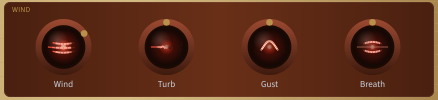
The Wind panel sits at the right end of the second control row, beside the Resonance and Pairing panels. It is a cherry-plank panel carrying the four wind knobs. The wind itself is shown drifting through the soundbox on the harp canvas below (see Harp Canvas), rather than across this panel.
Four rotary knobs sit on the panel on a single row, each labelled underneath. From left to right:
- Wind -- base wind strength. The knob does two different things either side of about two-thirds of its travel, and it is worth knowing which half you are in. Below that point it sets the register: opening it up lifts the sound from a deep hum into the singing range, because the strings are excited at the rate the wind sheds off them, and a faster wind sheds faster. Above that point it stops climbing and turns into force: the instrument gets stronger, denser and gustier in the register it has reached, the way a real harp roars rather than whistles in a gale, and pushing on past the turnover actually makes it slightly darker rather than brighter as the extra energy lands in the lower partials. The knob's response is weighted toward the low end, so the whole bottom half covers the gentle breeze register and calm, softly-locked sounds are easy to dial in. The whole range is musically usable -- the top of the knob does not thin the drone out into a bright hiss. If what you want is brighter or darker rather than stronger or gentler, reach for Bright (see Tone), which sets register across the entire range.
- Turb -- turbulence: the moment-to-moment jitter and chop of the wind. Higher values make the wind feel choppy and busy; lower values make it steadier. Turbulence also drives a small per-string phase wobble in the excitation, adding life to the tone. That wobble rides on the locked-in half of the sound, so you hear most of it in the singing register — the lower two-thirds of the Wind knob. Push Wind past its turnover into the roaring half and the strings are driven by broadband buffeting instead, which has no steady pitch to wobble, so Turb there reads purely as chop in the wind rather than as shimmer in the tone.
- Gust -- depth of the slow swells and lulls (~3 second cycles). Think of it as the weather: at zero the wind is steady (only the fast moment-to-moment jitter from Turbulence remains); at maximum the wind sweeps through deep, slow gust cycles. Each string sits in its own patch of moving air, so the swells arrive slightly staggered rather than lifting all twelve strings in perfect unison — the ensemble shimmers, swelling in loose succession the way a real aeolian harp does, while a big gust is still felt across the whole instrument.
- Breath -- how audibly the instrument breathes with each gust cycle. While Gust shapes the wind source, Breath shapes how deeply the wind's drive into the strings rises and falls with each slow gust: during a lull less energy feeds the strings, so notes already ringing simply decay naturally rather than the whole sound being ducked, and sympathetically-coupled tails ring on through the lull. The Breath knob is greyed out when Gust is at zero (it has no audible effect then).
The four knobs share the same cherry-ring + brass-indicator look as the IconControls above and below, so they read as a consistent set of tone controls.
All four knobs use JUCE rotary drag (vertical or horizontal mouse drag changes the value) and are fully DAW-automatable. Hover any knob to see a tooltip.