
FX -- Reverb and Delay

The plugin has its own reverb and delay, so it can stand on its own without anything after it in the chain. Both start switched off and completely dry: a patch you have already saved sounds exactly as it did until you reach for them.
They live in two places. The FX strip is the slim row just below the Wind panel, and it is what you see all the time:
- Each effect has a lamp. A lit brass disc means it is running; an empty ring means it is not. Click the lamp to switch that effect in or out where it sits, without opening anything.
- Beside each lamp, a value names what the effect is currently set to -- how much reverb is blended in, and for the delay, its timing and how much of it you hear. Click that value to open that effect's own panel.
- The FX button at the right of the strip opens the FX chain instead -- the picture of how the effects are wired together.
- The strip reads in the order the sound passes through the effects, so if you reorder the chain, the strip reorders with it.
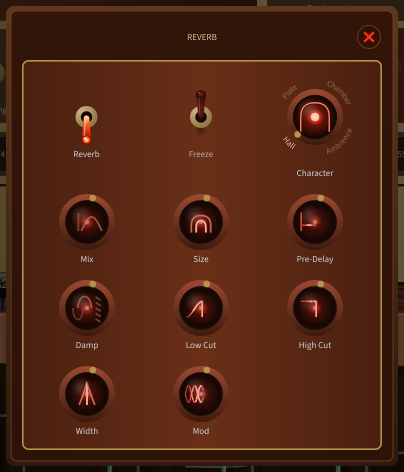
Each effect's panel opens over the instrument and holds all of its controls. Escape, the red ✕, or a click outside the panel closes it.
Reverb -- the space around the drone.
| Control | What it does |
|---|---|
| Reverb | Switches the reverb in or out (the same switch as the strip's lamp) |
| Freeze | Holds the tail where it is: the reverb stops taking new sound in and rings on until you release it |
| Character | The kind of space: Hall (large and slow), Plate (dense and bright), Chamber (tighter and woodier), Ambience (a short room that just sets the drone back) |
| Mix | How much of the tail is blended in with the dry drone |
| Size | How large the space is, and so how long its tail runs |
| Pre-Delay | The gap between the sound and the start of its tail. A longer gap separates the drone from its own reverb -- the single most useful control here for keeping a long tail from swallowing the instrument |
| Damp | How fast the tail's high frequencies are absorbed; higher is softer and woollier |
| Low Cut | Clears the bottom out of the tail so it does not muddy the drone's own low strings |
| High Cut | How much top end the tail keeps. Bring it down if a bright tail starts to sound harsh |
| Width | How far the tail spreads across the stereo field; at zero it stays in the centre with the drone |
| Mod | Gently detunes the tail. It is not at zero by default, on purpose: a long reverb on a sustained drone rings metallic without it |
Delay -- the repeats.
| Control | What it does |
|---|---|
| Delay | Switches the delay in or out (the same switch as the strip's lamp) |
| Sync | Locks the repeats to your host's tempo. With Sync on, Division sets the note value and Time is greyed out; with it off, the pair swaps |
| Division | The note value the repeats follow, from a 32nd up to a whole note, including triplets and dotted values |
| Mix | How much of the repeats is blended in with the dry drone |
| Time | The gap between repeats in milliseconds, when Sync is off |
| Feedback | How much of each repeat is fed back in, and so how many you hear. At maximum the line freezes and holds what is in it |
| Ping-Pong | How far each repeat is thrown to the opposite side; at zero both channels run straight |
| Offset | Nudges the two channels' repeats apart in time, in either direction; at zero they land together |
| Duck | How far the repeats drop out of the way while the drone is loud, springing back as it falls away |
| Damp | How much top end each repeat loses on its way round, so the echoes darken as they fade |
| Low Cut | Clears the bottom out of the repeats so they stay out of the drone's way |
| Mod | Tape-style wow and flutter on the delay line, so the repeats drift rather than sit still |
Changing the delay's timing while it is sounding bends the pitch of what is already in the line, the way a tape delay does. That is deliberate, not a fault -- if you want a clean change, drop the Mix first.
Every one of these is a normal automatable parameter and appears in your host's parameter list, and every control in the panel takes the keyboard exactly as the main panel's do (see Keyboard Control below).
The FX chain
The FX button on the strip opens the FX chain -- the sound's path through the effects, drawn left to right from IN to OUT, with one block per effect and an arrow between them.
- Each block has the same lamp as the strip, so you can switch an effect in or out from here.
- Click a block to open that effect's own controls.
- Drag a block left or right to change the order the effects run in, or use the ‹ and › buttons on the block if you would rather not drag. The blocks either side move out of the way as you drag, so you can see where it will land before you let go.
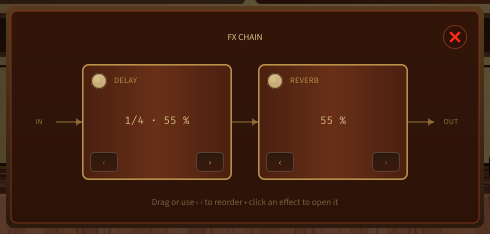
The order matters, and both ways round are useful. Delay before Reverb -- the way it starts -- sends each repeat into the room, so the echoes stay separate and articulate. Reverb before Delay echoes the whole wash instead, which smears it into something larger and less defined. On a slow drone the first is usually the clearer choice; the second is worth reaching for when you want the tail itself to repeat.
Reordering does not cut anything off: whatever the reverb and delay are already holding keeps ringing through the new path.
The order is saved with your patch and is automatable like everything else -- it appears in your host as Delay Chain Slot and Reverb Chain Slot, each naming that effect's place in the chain.