An Instrument With No Performer
An aeolian harp is a stringed instrument played entirely by the wind. Named after Aeolus, the ancient Greek god of the wind, it needs no human hands — only a current of air flowing across its strings. As wind passes over a string it sheds tiny whirlpools of air, von Kármán vortices, peeling alternately off opposite sides. These oscillating pressures push and pull on the string, and when the shedding frequency meets one of the string's natural resonances, the string sings. This is lock-in.
Because the strings are excited by wind rather than plucking or bowing, the tones rise and fall organically with gusts and lulls. A string may begin at one harmonic, then shift to another as the wind speed changes; several strings sounding together weave rich, beating textures as their overtones interact. The result is an ethereal, constantly evolving soundscape — unpredictable, and deeply musical.
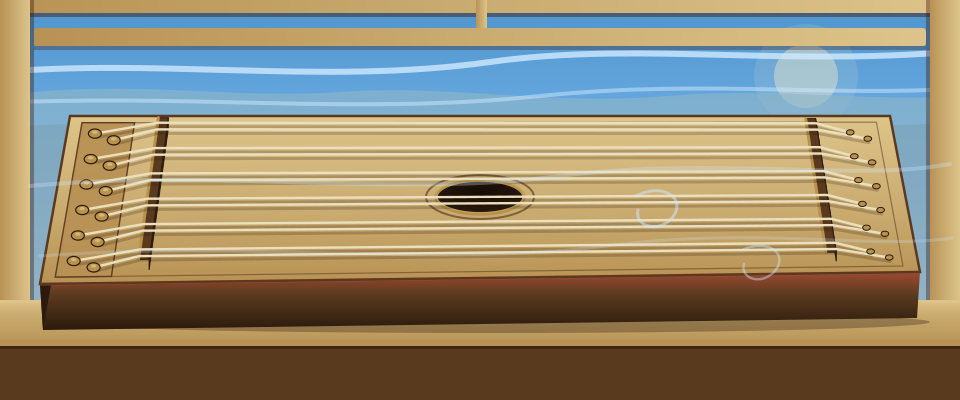
The instrument is a long, shallow soundbox — traditionally set on a windowsill or built tall enough to stand in open ground. Its strings run the length of the box over a bridge at each end, tuned at one end with pegs and hitched at the other. Twelve of them, in six paired courses, is a common stringing, and it is the one modelled here.
The Physics, Modelled
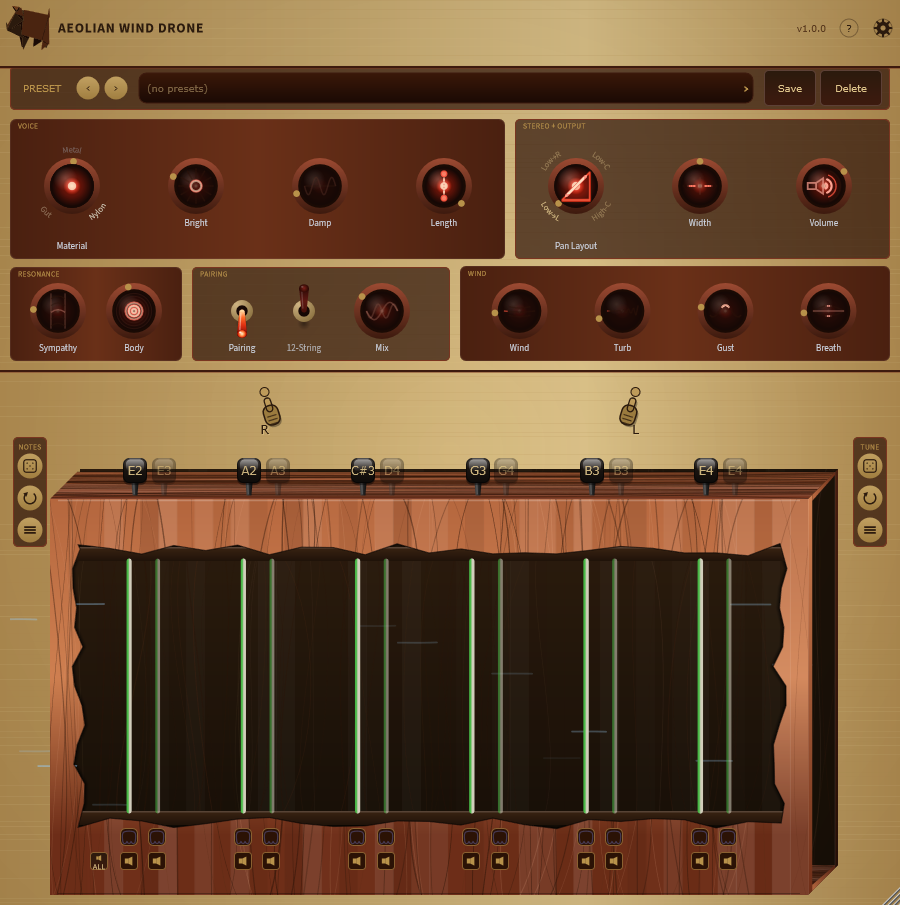
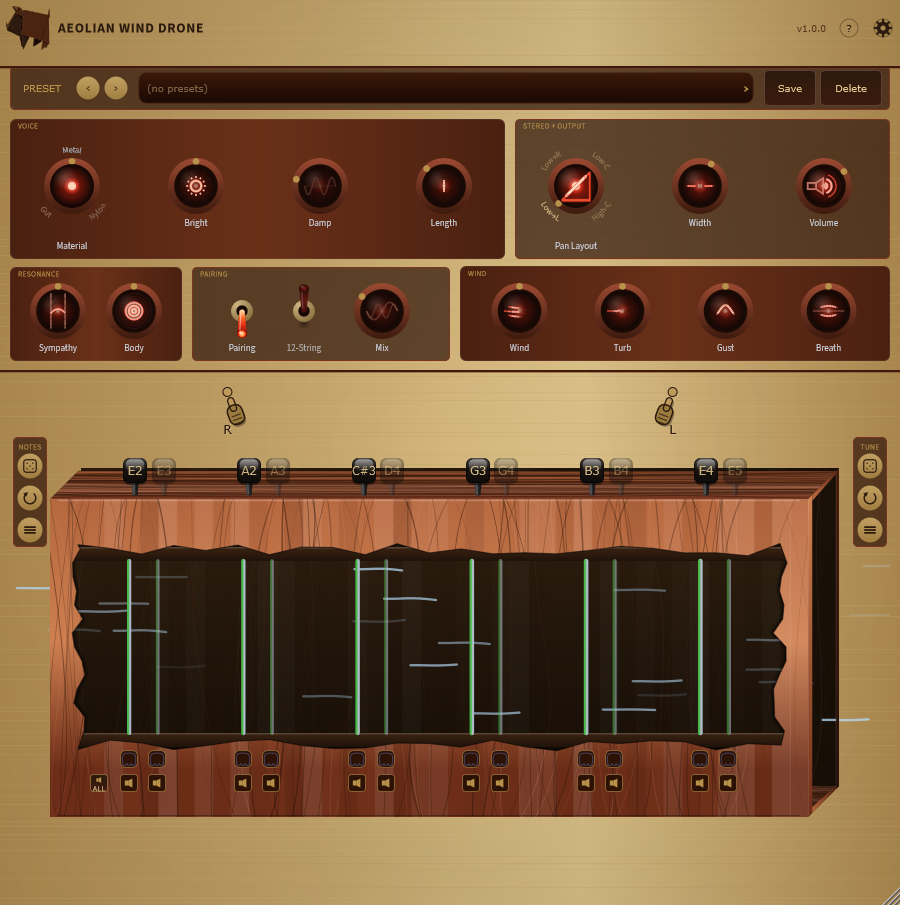
Aeolian Wind Drone recreates these phenomena digitally. Twelve strings are arranged in paired courses, like a 12-string guitar. Each string has its own vortex exciter responding to a shared wind simulation, and a digital waveguide string model that produces the resonant tone. The lock-in window for any harmonic is narrow, so as the simulated wind breathes, different harmonics of different strings drift in and out of resonance — the same continuously shifting texture that makes a real wind harp impossible to stop listening to.
String material matters, just as it does on the physical instrument: metal strings are bright and sustain longest, gut strings are warmer and more traditional, and nylon strings speak softer and darker. The strings also hear each other — sympathetic resonance lets an unmuted string ring in reply to its neighbours, exactly as it would across a real soundbox.
Key Features
- Twelve physically modelled strings — digital waveguide synthesis, arranged in paired courses
- Von Kármán vortex-shedding excitation — a per-string exciter fed by one shared, living wind model
- A wind you can shape — strength, turbulence, gust depth, and breath
- Sympathetic coupling — strings resonate in reply to one another across the soundbox
- Three string materials — gut, metal, and nylon, each with its own voice
- Body resonance — a modelled soundbox colours the ensemble
- Per-string control — note, fine tuning in cents, mute, and ghost-mute for every string
- Stereo field — width and selectable pan layouts
- Factory presets — a curated built-in bank, plus your own saved presets
- A living interface — watch the strings vibrate in real time; resizable from 75% to 300%
- Optional MIDI performance — controllers shape the wind, held chords retune the strings, Program Change swaps presets, and the harp can send back the notes the wind is playing
Formats
Aeolian Wind Drone is available as a VST3 plugin and a standalone application on Windows, macOS, and Linux, plus an Audio Unit (AU) on macOS for Logic Pro and GarageBand. Pro Tools (AAX) is not supported. No performer required — set the wind, and let it play. Or take the controls: MIDI can tune and stir the wind, and the harp will tell your DAW what the wind is doing.